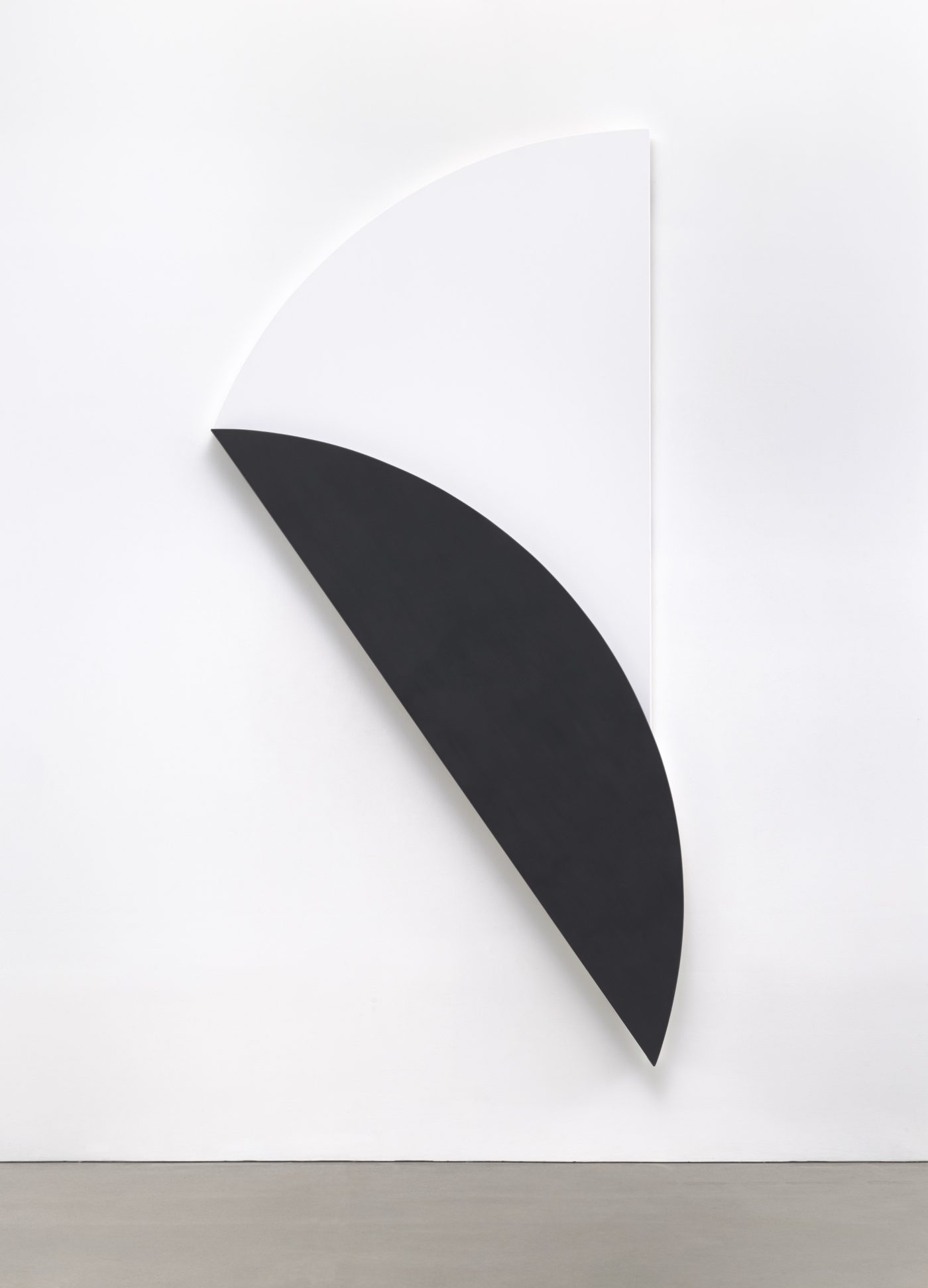
Ellsworth Kelly (Newburgh, New York, 1923 – Spencertown, New York, 2015) was an American painter, sculptor, and printmaker whose work occupies a central place in postwar abstraction, defined by spare geometric forms, sharply defined edges, and luminous fields of color that stood apart from the gestural intensity of Abstract Expressionism.
Kelly's paternal grandmother introduced him to ornithology as a boy, and bird-watching's patient, close observation shaped his eye before art school did. He studied technical drawing at Pratt Institute, then served in the 603rd Camouflage Engineer Battalion, the "Ghost Army" that used inflatable tanks and deception to mislead German forces, an early education in silhouette and illusion. After the war, he studied in Boston and then, on the G.I. Bill, at the École des Beaux-Arts in Paris, where he met Jean Arp, Constantin Brancusi, Alexander Calder, and Joan Miró and began moving away from representation.
Kelly's mature language grew directly out of looking rather than inventing from nothing: a shadow cast by a stairwell, the gap between two window shutters, the curve of a plant leaf could each be isolated, flattened, and enlarged until the observed fragment became an autonomous field of color with no remaining trace of its source. Returning to New York in 1954, he pursued crisp contours and saturated color that seemed to exist as objects rather than images, and became one of the first postwar artists to work extensively with shaped canvases; because these panels have no rectangular frame to contain them, their edges act directly on the surrounding wall, so that color, architecture, and viewer register as a single perceptual event rather than a picture hung upon a surface.
Kelly's achievements were recognized with the National Medal of Arts in 2012 and France's Légion d'Honneur in 2009, and his work entered major museum collections following retrospectives at the Museum of Modern Art (1973), the Stedelijk Museum (1979), and the Guggenheim Museum (1996). His final work, Austin, a freestanding stone building with luminous colored glass windows first designed in 1986, was completed at the Blanton Museum of Art in Texas in 2018, three years after his death; he described it simply as a place to "rest your eyes, rest your mind."