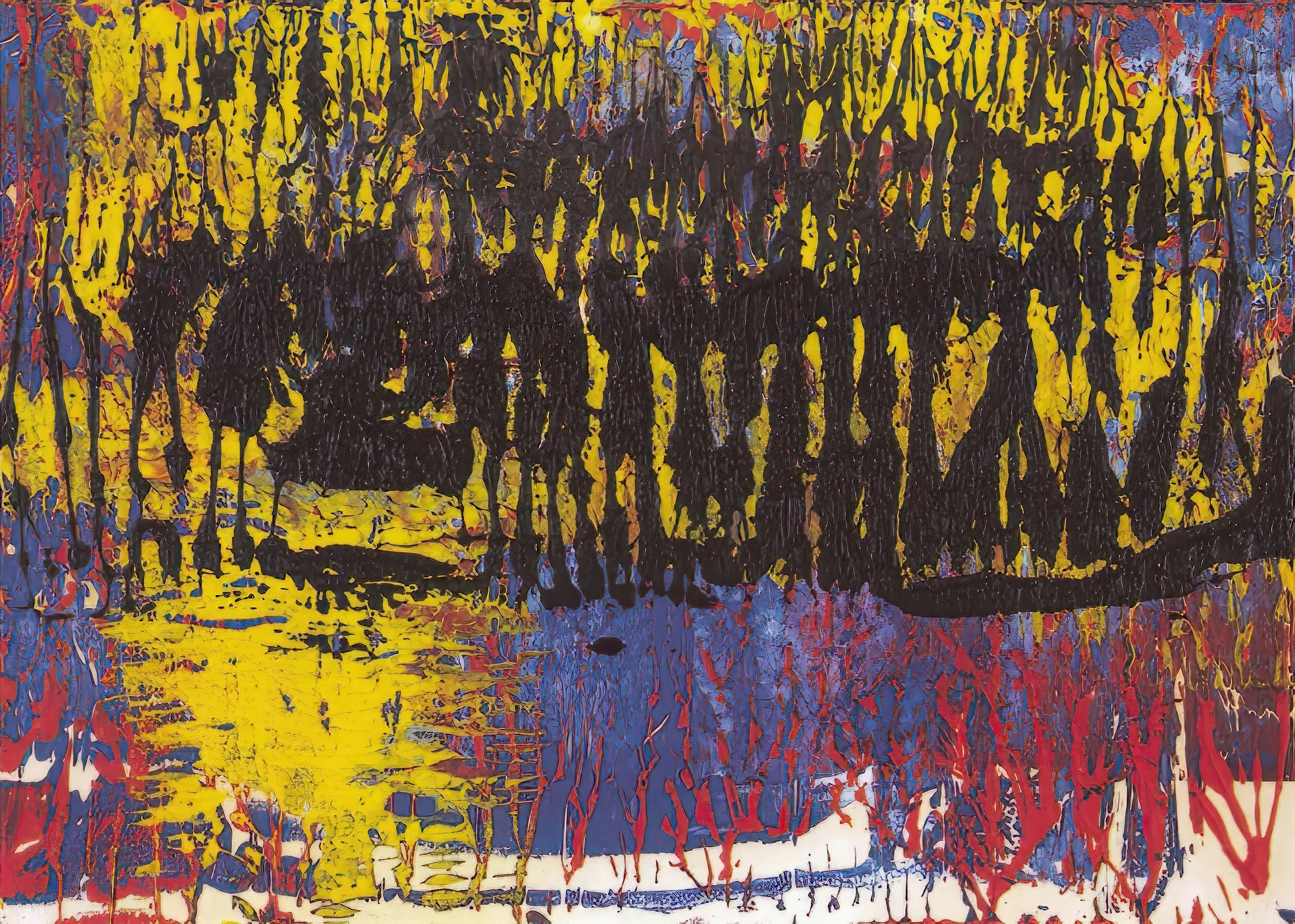
Gerhard Richter (b. 1932, Dresden, Germany) has spent more than six decades testing what painting can still do in an age dominated by photography, refusing to settle into either photorealism or pure abstraction and treating the tension between them as his true subject.
Richter trained first in East Germany, working on socialist-realist murals as a young painter, before fleeing to the West in 1961, mere months before the Berlin Wall closed the border for good, and enrolling at the Kunstakademie Düsseldorf. There he began compiling what became Atlas, a growing private archive of found and personal photographs, press clippings, and sketches that he has continued to expand for decades and that supplies the raw material for much of his painting. From this archive came the blurred, photo-based paintings for which he first became known: he projects a photograph onto canvas, traces its outlines, then drags a dry brush across the wet paint to soften and destabilize the image, holding it somewhere between documentary record and its own dissolution.
Richter's most historically charged use of this method is the cycle 18 October 1977 (1988), fifteen grey, deliberately blurred paintings based on police and press photographs of the deaths of Andreas Baader, Gudrun Ensslin, and Jan-Carl Raspe, members of the militant Red Army Faction, in Stammheim Prison; the Museum of Modern Art acquired the cycle in 1995, a turning point in his American reputation. His abstractions range just as widely, from large gestural paintings built up and scraped down with an oversized squeegee, emphasizing the sheer physical presence of paint over any image beneath it, to cooler, systematic color chart paintings that catalogue chance combinations of hue according to a fixed set of rules. His oeuvre extends further still, into sculpture, glass, and photography.
Major retrospectives, including Panorama, organized jointly by Tate Modern, the Centre Pompidou, and Berlin's Neue Nationalgalerie in 2011–12, have traced this work across painting, photography, and archive in one sustained arc. Asked about the purpose of art, Richter has said it exists, in part, "for surviving this world." His paintings are held in the collections of the Museum of Modern Art, Tate, and the Centre Pompidou, among many others. Richter lives and works in Cologne, Germany.