
Manolo Valdés

Manolo Valdés

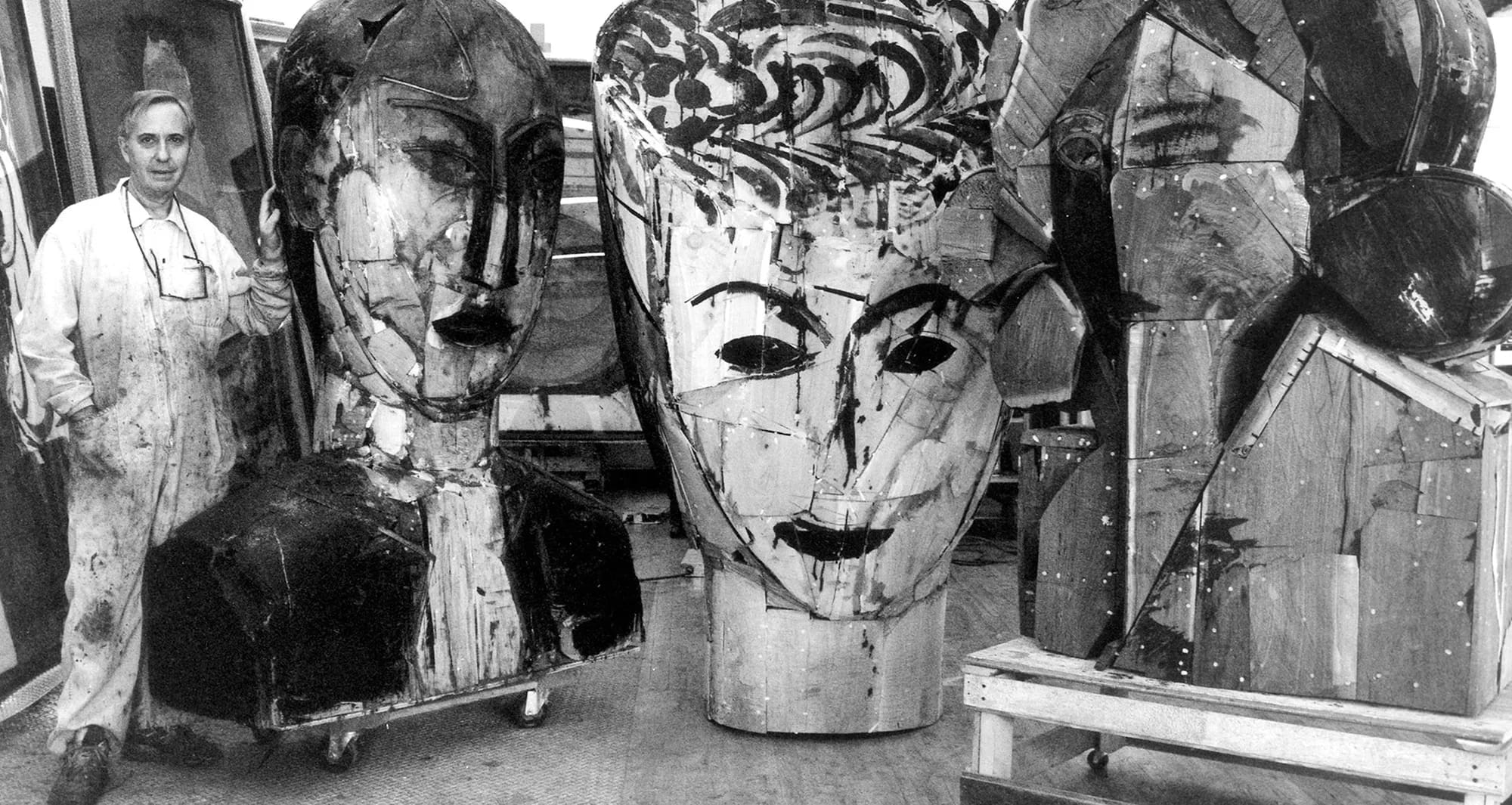
Manolo Valdés (b. March 8, 1942, Valencia, Spain) rebuilds canonical images from art history at monumental scale, stripping a single recognizable motif, an Infanta's collar, a Roman bust's profile, down to bold, simplified form and reconstructing it in burlap, scored wood, or weathered bronze until the surface itself, cracked, layered, or coarse, becomes as much the subject as the borrowed image.
Valdés enrolled at the San Carlos School of Fine Arts in Valencia in 1957 but left after two years, having already held his first solo exhibition at the Nebli Gallery in Madrid in 1962. In 1964, with Rafael Solbes and Juan Antonio Toledo, he co-founded Equipo Crónica, a collective that broke with the dominant Art Informel to develop a pop-inflected, narrative style used as direct political and social critique under the Franco dictatorship; Toledo left within the first year, but Valdés and Solbes continued collaborating, jointly signing their work, until Solbes's death in 1981.
After Solbes died, Valdés reinvented himself as a solo artist and turned to the history of art itself as his subject, above all the Spanish old masters Velázquez and Goya, alongside Rembrandt, Matisse, and Picasso. His reworkings of Velázquez, particularly the Infanta Margarita of Las Meninas and Queen Mariana of Austria, abandon narrative and illusionistic detail entirely in favor of a single silhouette rebuilt at a scale and material weight, burlap stretched taut, aluminum sheet, cast bronze, that has no equivalent in the paintings he is quoting.
Valdés represented Spain at the 1999 Venice Biennale and received museum surveys at the Guggenheim Bilbao in 2002 and the Museo Reina Sofía in 2006. A monumental bronze bust stands in the Place Vendôme in Paris, one of many public installations of his work internationally, and his paintings and sculptures are held in the collections of the Centre Pompidou and the Metropolitan Museum. He divides his time between New York and Madrid.